
What the Numbers Say
Surveys show Israel is getting less democratic, Arabia less friendly, and America more antisemitic

How has the October 7 War affected Israelis, Arabs, and the Diaspora religiously and politically? I’ve had my hunches, and recent surveys and reportage seem to confirm them.
Religion
Old-line non- and anti-Zionist haredim have always worn tallit katan tzitzit tassels outside their trousers. But nowadays other Israelis are garbed more ‘religious.’ Maybe it started with the Hardal, or haredi-national religious community, and their hilltop youth offshoots, who have taken to wearing longish tzitzit outside their cargo trousers or jeans. Rounding out their scruffy looks with dangling payot and supersized knitted kipot. Meanwhile, national-religious moms are wearing bigger and more elaborate headdresses.

The bigger change is that many previously nonobservant young people, some from modest socio-economic backgrounds, track-suited soccer ruffians among them, have lately adopted accoutrements that frum signal. It might be a trademark Chabad messianic kipa emblazoned in Hebrew with the mantra Yechi Adoneinu, Moreinu v’Rabbeinu, Melech HaMoshiach L’olam Va’ed! or a skullcap from the Rebbe Nachman of Breslov messianic franchise, Chabad’s lesser competition, which has its own catchy Na Nach Nachma Nachman Me’uman motif.


From ancient days to the early modern period, dark times accelerated religious and messianic longings. And the trauma of October 7 is no different. A Hebrew University study found that one in four Israeli undergraduates has become more fervently religious since October 7. Only a minority has moved further away from belief. Bear in mind that few Israelis start out as secular in the atheistic Western sense, even when they are not religiously observant.
Separately, a Jewish People Policy Institute survey found that 27% of Israeli respondents said they had become more observant, 8% less observant, and the rest said they had not changed their religious observance at all.
Among the younger set, however, 33% reported becoming more observant.
Spiritual seekers and searchers are seldom seduced by centrist or moderate Orthodoxy, let alone progressive streams in Judaism.
They like the more authentic Polish-gentry look in winter. Yair Ettinger, the Kan (Kol Yisroel) religious affairs reporter, has shown how charismatic ultra-Orthodox rabbis (with an assist from their technocratic beadles) have used TikTok to become influencers. Their targets are heretofore non-Orthodox Gen Zs; their messaging proffers an antidote to social media anomie: physical embrace, affiliation, and purpose. Once a soul is saved, its electoral spirit can be channeled to Netanyahu’s Likud or one of his interconnected Haredi or Hardal affiliates. Otherwise, the newly-saved are cautioned, the traitorous, Godless, leftists could seize the Knesset.
Diaspora & Israel Drifting Apart
My Jewish friends and family in the Diaspora have been profoundly affected by the war. A survey of Jewish Life Since October 7, conducted by the Federations of North America in March 2025 and released just this month, caught my attention. Yes, most still root for Israel. But look deeper:
Some 63% of US Jews do not identify as Zionist, though nearly nine in 10 support the right of a Jewish and democratic state to exist — thank you very much.
About 14% of the 18 to 34-year-old US Jewish cohort identifies as anti-Zionist. Among this age group, just 35% lean toward Zionism.
A significant minority of US non- and anti-Zionists Jews erroneously believe that Israel is (already) an apartheid state.
Longtime Prime Minister Binyamin Netanyahu continues to drive a wedge between Israel and the Diaspora. He’s rebranded the Zionist enterprise in his own morally murky image. His Hardal (read: settler) and haredi (read: non-IDF-serving) coalition allies have further reinforced the sense that the Israeli government has less and less in common with the non-Orthodox Diaspora majority.
What’s most disheartening to me is that if Knesset elections were held now, Netanyahu’s Likud would win a plurality of the seats, according to all the polls I have seen.
Government ministers rambling on about re-settling Gaza and their obsessive drive toward de facto annexation of the West Bank have little support among rank-and-file US, Canadian, or UK Jews. Nor do a majority of Israelis have any interest in annexation.
Jew Hatred
All the while, the Diaspora is paying its own steep price for October 7. Antisemitism in the US is growing deep and wide; Jews feel it; one in three has been targeted; young people have suffered the most. Everyone is feeling less secure. And most seem to understand that anti-Israelism is often a kissing cousin to antisemitism.
Even as a never-Trumper, I don’t blame the spike in antisemitism entirely on Donald Trump.
The Woke-Islamist-Red axis exploited the October 7, 2023, Hamas massacre of Israelis with alacrity to mobilize masked and kafiyah-clad brigades of the gormless (some of them “As-a-Jews”) and the haters to bleat, bla, and blat: “From the River to the sea. Palestine will be Free.” They created an unremittingly hostile environment for Jews on the streets and on campus.
Our pretend redeemer, Donald Trump, in fact serves as an antisemitism accelerant. I’m not just thinking about Candace Owens (”synagogue of Satan”); Nick Fuentes; Jeremy Carl; Darryl Cooper; Tucker Carlson; Carrie Prejean Boller; Sameera Munshi; Kingsley Wilson; Timothy Hale-Cusanelli; Ian Carroll; Stew Peters; Paul Ingrassia; Ed Martin; Jeremy Carl; and Marjorie Taylor Greene…
No, I am thinking of the destructive impact on Jewish security of an unpredictable demagogue in the White House inclined to rouse the rabble and to deconstruct the Madisonian model of constitutional democracy.
For American Jews, it’s a quintessential Hobson’s choice: Woke or Trump? Having to pick between antisemitism, anti-Israelism, or some toxic concoction of the two is no choice at all.
Elsewhere in the Middle East
I have also been looking at the 2025 Arab Opinion Index from Qatar, which, based on face-to-face interviews, surveyed 15 Arab countries, including Palestine (meaning the West Bank and Gaza). For purposes of exposition, I will assume this survey is no less statistically accurate as a snapshot of opinion at a particular moment than any of the other polls I cited above.
The survey demonstrates that most Arab states, whether they are “failed” or not, are mere constructs to the people who live in them. While there are 22 states in the Arab League, 76% of the Arabs “agreed with the sentiment that the region’s inhabitants form a single nation.”
There is economic optimism in the Arab world, with 57% of respondents indicating that their countries were on the right track. That said, 25% would be glad to migrate to improve their economic lot. Though fewer than a third would choose to emigrate to the US or go there for medical treatment or professional training.
Some 63% said the political and security situation in their countries was just fine. Yet, overwhelmingly, people felt that financial and administrative corruption was widespread.
When asked about their attitude toward democracy, most people favored it. They define democracy as a system guaranteeing civil liberties.
On the other hand, asked “Would you accept a political party with whom you disagree taking power through free and fair elections?” Only 50% said yes; 41% said no; and 9% were not sure. (Reminds me of Trump rejects projected Biden win, says ‘election far from over’)
Arab attitudes toward Israel
A plurality of 44% of the Arabs polled said Israel posed the greatest threat to the Arab nation, with the US coming in at 21% and Iran in third place with six percent. Some 87% of those surveyed opposed recognizing Israel (this datapoint was little different from the 84% who opposed recognition in 2011). The reason cited by a plurality of those polled: “Because Israel is a settler-colonial state occupying Palestine.” I think they mean from the River to the Sea.
Predictably, 80% of Arabs in the Middle East see backing the Palestinians as a collective responsibility.
Like many Israelis and Diaspora Jews, some 87% of Arabs in the region said they had been psychologically stressed out by the October 7 War.
Rating non-Arab countries, Arabs saw South Africa (62%), Turkiye (49%), and Iran (45%) as the most supportive of Palestine. On the unhelpful side, rounding out the bottom were France (23%), the UK (19%), and the US (11%).
Curiously, Iranians, despite backing Hezbollah, Hamas, and the Houthis against Israel, were rated “very” supportive of Palestine by an average of just 13% of the Arabs, 32% rated the Persians “good”, and 18% declined to answer. Interestingly, 21% rated Iran “bad” and 16% “very bad” on Palestine.
In the same survey, Palestinians in Gaza were asked if the October 7 war had displaced them. Some 93% of those polled said they had been dislocated at least once. Most said they could not get the medicines they needed and had personally experienced hunger multiple times.
Incidentally, in case you missed it, Israeli authorities are no longer denying that some 70,000 Gazans (combatants and non-combatants) were killed in the war, just as the Hamas health ministry claimed.
Far fewer civilians would have been hurt if Hamas had not used them as human shields, not used hospitals and schools as firing points, and had allowed them to shelter in its vast subterranean subway system.
Israel has become more lawless
My sense is that Israel is far more lawless since October 7. For instance, 54% of bus drivers — I venture to say, most being Arabs — have recently been physically attacked by loutish Jewish passengers. This week, in Arab-on-Arab violence, five Arab men were killed within 12 hours — making at least 46 Arab victims since 2026 began. The Israel Police, under Itamar Ben-Gvir, seems to be standing on the sidelines.
It is bedlam on the roads. Israel ended 2025 with 455 road fatalities; so far in 2026, there have been 47 traffic fatalities. Public service radio announcements plead with drivers to stop at red lights!
On the West Bank, in January 2026, more Arabs have been victims of Jewish terror than the other way around. From my viewpoint, this is not Yiddishe Nachas.
Israel’s democracy is withering
Spearheaded by Netanyahu’s Justice Minister, Yariv Levin, I see our political system devolving into an intolerant populist democracy of raw majority rule. Netanyahu and company continue to concentrate control over education, media, judiciary, and the national security apparatus in the hands of the ruling Likud Party and its affiliated Hardal and Haredi satellites.
The still-unfinished judicial putsch is now metastasizing throughout Israel’s body politic. Army Radio and Channel 13 are now threatened.
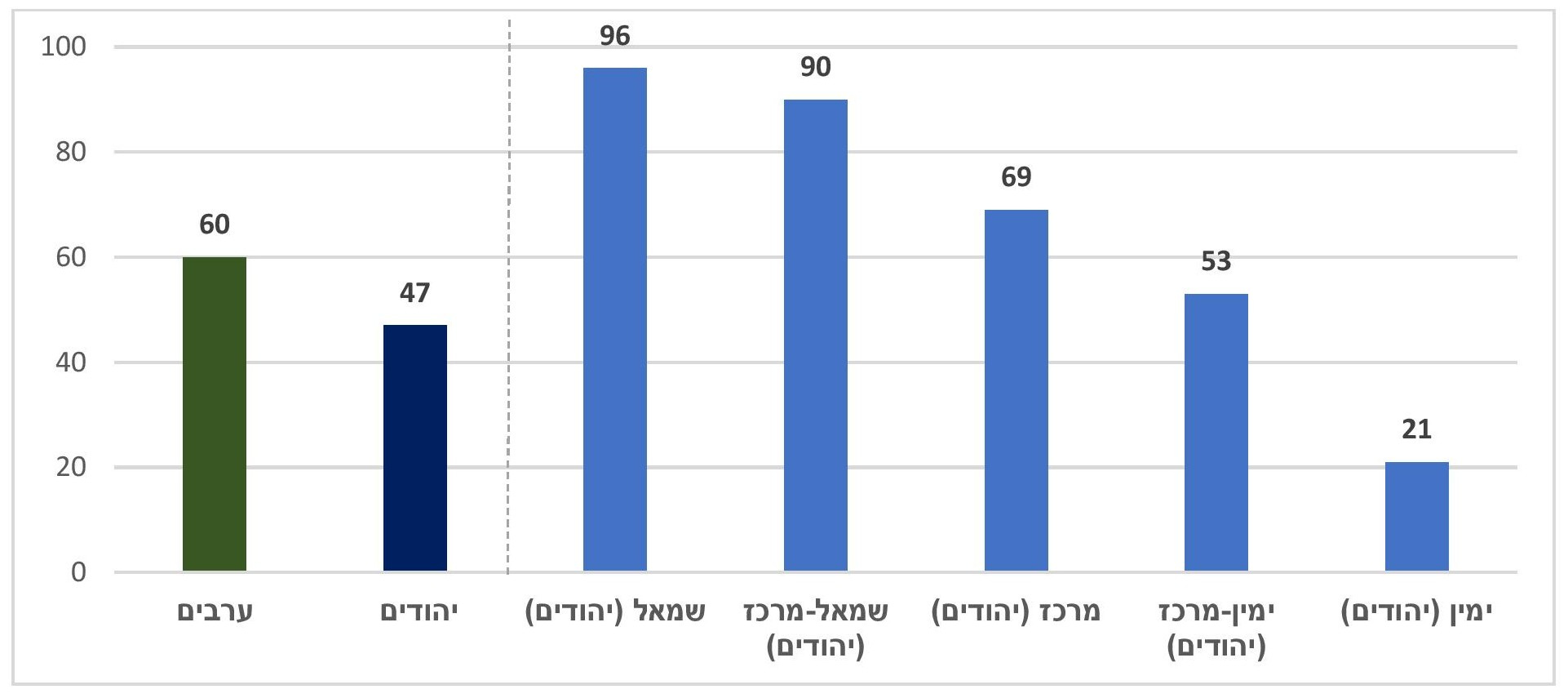
An Israel Democracy Institute survey (see below) found that most Jews and Arabs (except Jewish Israelis on the extreme right) agree with former Supreme Court Justice Aharon Barak that Israel is no longer a liberal democracy.

I am not yet ready to give up on an Israel that is a representative democracy espousing democratic values, classical Zionism, a Jewish ethos, tolerance, and civil liberties. Are you?