
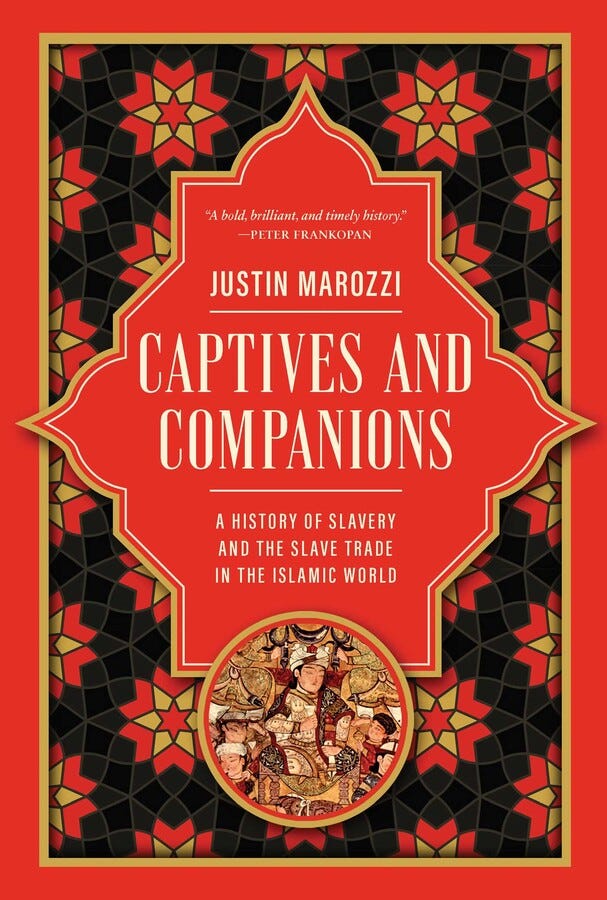
Maybe someone at Simon & Schuster publishers had the foresight to underplay journalist Justin Marozzi’s superbly woven “A History of Slavery and the Slave Trade in the Islamic World,” imposing the comparatively less descriptive Captives and Companions as the book title – essentially switching the subtitle for title. Who needs another Salman Rushdie-like fatwa?
What matters, though, is that the book credibly and exhaustively details the interlocking connection between Islam’s founding expansionist ethos and its tendency toward enslaving mainly dark-skinned peoples. There will be critics with a vested interest in wriggling out of this harsh truth who will lash out against this book, notwithstanding its inoffensive title. The fact is that Marozzi has not penned an anti-Muslim screed. What he’s done is to lay out plainly how interconnected Islam and slavery were.
Slavery in the Islamic world evolved over time and place. The Islamic Slave Trade that enslaved Africans and others – including many Muslims – was separate and distinct from the Atlantic Slave Trade, which abducted into captivity millions of Africans to the New World. Beyond these two odious systems, there was an internal African slave trade – all interconnected yet distinct.
In some circles, it is considered impolitic to call attention to the Islamic Slave Trade on the grounds that it detracts from European culpability in the Atlantic Slave Trade. Yet I still find it odd that few African Studies Departments at US universities devote courses to the Arab and Muslim slave trade. And while there are published journal articles and some worthy overlooked histories on the subject, the last prominently received book on Islamic slavery was, I think, Bernard Lewis’s 1992 Race and Slavery in the Middle East.

Marozzi argues that the horrible machinery of the Atlantic and Islamic slave trades were comparable. The Atlantic Slave Trade blighted humanity from the 15th to 19th centuries and ensnared some 14 million Africans. Only in 1807 was slavery abolished in England, and not until 1865, with the end of the American Civil War, was the peculiar institution stamped out in the US.
In contrast, the Islamic Slave Trade ran from the 7th to the 20th century, trapping 12-15 million souls – perhaps as many as 17 million. Officially, it was abolished under European pressure in 1857, when the Ottoman Turks were the dominant Muslim power. Still, slavery persisted in Iran (1928), Yemen (1962), Saudi Arabia (1962), Turkey (1964), Oman (1970), and Mauritania (1981). As late as 2017, a CNN journalist came upon a Libyan slave market where people were auctioned for $400. The book details the recent brutalization of the Yazidis, a religious schismatic Kurdish-speaking minority in northern Iraq, by the Islamic State. Most likely, the practice continues wherever Islamist insurgencies are capturing territory in Africa and Asia.
Slavery & Islam’s expansion
Islam inherited the ancient phenomenon of slavery from pagan Arabia, then recast it in its own image through the Koran, Hadith, and Islamic jurisprudence or Fiqh. The Prophet promised warriors who spread the faith the divinely-sanctioned rewards of jihad. Either material and sexual benefits in this world, such as booty and slaves, or with martyrdom, sexual rewards in the next world. Thus, starting with Islam’s founding in 622, the prospect of enslaving conquered peoples was an incentivizing force for Muslim civilization as it burst out of the Arabian Peninsula, reaching Iberia (711) in Europe and deep into Central Asia (705).
Islam’s Prophet and founder, Mohammed, led by example. Early on, he executed the men and enslaved the women and children of the Arabian Jewish tribes he vanquished. The Prophet himself had no fewer than 60-70 slaves. Under Islam, a person became enslaved by being captured in a conquest or being born into slavery. Talented, fortunate slaves could gain their freedom. A notable example was Bilal ibn Rabah, an enslaved African whom Muhammad appointed as the first muezzin in Islam, tasked with calling the faithful to prayer.
The Koran (8:1,48:20, and 8:69) gives divine sanction to taking war booty, crushing the infidel (Byzantine Christians, for instance), and enslaving the defeated. Sexual intercourse with an enslaved woman is deemed “free from blame.” Captive women – those “whom your right hands possess,” i.e., your property, are granted to you sexually by Allah (4:24).
Racism
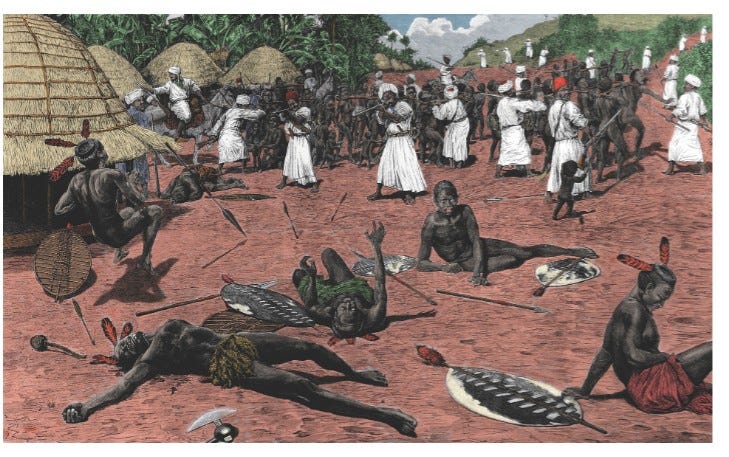
The first Muslims were Arabs. With Islam’s expansion, Berbers, Persians, Turks, and others converted and adopted the religion’s ethos. Racism – the notion that some races are biologically inferior – was endemic among the Arabs. This poem by Al-Jahiz (776–868) captures the sentiment:
We know that the Zanj [Africans] are the least intelligent of men, the least discerning, and the least concerned with their future. Like the crow among mankind are the Zanj, for they are the worst of men and the most vicious of creatures in character and temperament.
Ibn Qutayba (828–89), an Islamic scholar, held that “Blacks are ugly and misshapen, because they live in a hot country. The heat overcooks them in the womb and curls their hair.” It was their destiny to be enslaved.
Several Muslim writers, including the historians al-Masudi (896–956) and al-Tabari (839–923), reinterpreted the Noah story in the Book of Genesis (9:20–27) to justify slavery. They read into it that Noah’s son Ham was black and that his black descendants – Canaan – were cursed with eternal servitude.
As anyone with elementary Jewish literacy understands, slavery in ancient Jewish civilization was neither racial nor inherited. The Hebrew Bible relates that Ham saw his father’s nakedness while Noah was drunk: “And Noah woke from his wine, and he knew what his youngest son had done to him [presumably he’d been sodomized]. And he said,
Cursed be Canaan,
The lowliest slave shall he be
To his brothers
Curiously, it is Canaan, not Ham, who is cursed. The Hebrew Bible makes no mention of either of them being Black. Yet contemporary African American antisemites, with the Nation of Islam in the vanguard, hold the Jews uniquely responsible for the African slave trade, accusing the Talmud of germinating the “curse of Ham” slur.
Granted, neither the Five Books of Moses nor the Talmud, in all its arcane obtuseness, and redacted circa 500 CE, is politically correct. The Tractate Sanhedrin 108b, in parsing a aggadic folktale about who was having illicit sex on Noah’s Ark, relates that “Ham was afflicted in that his skin turned black” for having sexual intercourse with his wife on board. Other translations prefer the more literal “smitten in his skin” (laka be-oro). Crucially, Sanhedrin 108b does not mention slavery.
Jewish scholars, anyway, understood the curse as a prophetic statement about the Canaanite nations who inhabited the Land of Israel prior to the Israelite conquest. Ham had four sons: Cush, Mizraim, Phut, and Canaan. If the curse were hereditary and racial, it would apply to all of Ham’s descendants. In fact, the Bible views other branches of Ham’s family — North African, Egyptian, and Ethiopian — as powerful empires, subservient to none. For readers who want to delve further, I recommend The Curse of Ham by David M. Goldenberg.
None of this is to suggest that Jewish people are any less or more prejudiced or any less or more prone to outright racism than anyone else. In the pre-Civil War period, diplomat Mordecai Manuel Noah (1785-1851) was a decided champion of racial slavery. Judah Benjamin was the Confederate Secretary of State during the Civil War. On the flip side, the expansive history of Jewish community involvement in the civil rights movement is well documented. The crucial distinction lies here: while Islamic civilization assimilated racial slavery into its social fabric, Jewish civilization never elevated race into a measure of human standing.
By way of illustration, the Muslim philosopher Ibn Sina (980-1037) insisted that in the permanent order of the world, there had to be masters and slaves. Ibn Khaldun (1332-1406), often called the first sociologist, considered Africans akin to dumb animals.
Significantly, Africans who converted to Islam were not immune to enslavement.
Writes Marozzi:
As Muslim African states found to their cost and ruin for many centuries to come, their status as fellow Muslims, supposedly an inviolable legal protection against enslavement, all too frequently offered no defence against the rapacious greed of slavers with eager markets to satisfy. In 1391, for example, the Muslim king of Bornu, today’s northern Nigeria, sent a desperate letter to the Egyptian Sultan Barquq (r. 1382–9; 1390–99), himself a former slave, beseeching him for urgent assistance against marauding Arab slave raiders who were ransacking his kingdom and enslaving his people, their co-religionists. ‘These Arabs have devastated all our country, the whole of Bornu,’ he wrote. ‘They have seized our free men and our relatives, who are Muslims, and sold them to the slave dealers of Egypt and Syria and others; some they have kept for their own service.’
As in all faith traditions, values and laws on the books aren’t necessarily put into practice by clerics and laypeople. For example, Muslim owners did not routinely free their slaves even though it is meritorious to do so. Castration is prohibited in Islam, but this horrid practice was widespread as eunuch-slaves were especially prized. Marozzi devotes a chilling chapter to the torturous journeys of the eunuchs. No matter how much power they may have ultimately accumulated, their earliest memories were as boys kidnapped away from their families and ripped from their villages by “Arab slavers riding into peaceful African villages like the horsemen of the apocalypse.” The best and brightest became viziers; others, keepers of the harem. In Arabia, they served as guardians of the Prophet’s Tomb at Medina.
Islam prizes women’s modesty. Yet, the best many a fortunate, talented, and rarefied enslaved woman could hope for was to become a courtesan, singer-dancer, or poet. Even then, they still had to cater to the carnal pleasures of often inebriated, powerful men. More typically, enslaved women were treated little better than sex workers.
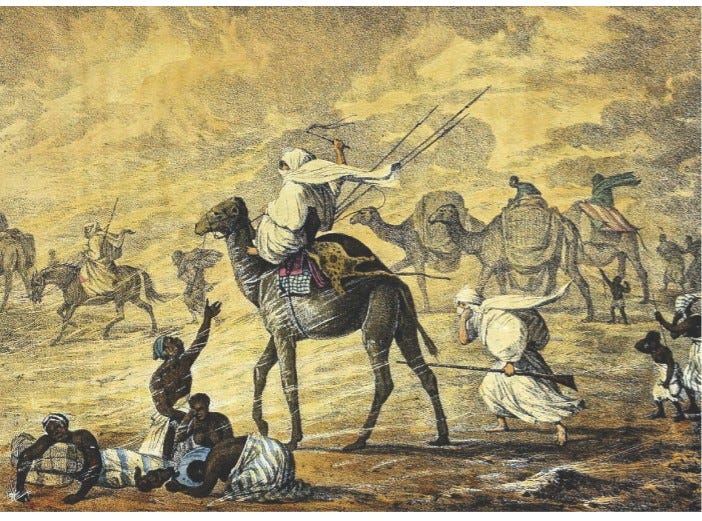
Slavery also stoked the ranks of Islam’s military. Muslim rulers created slave-based armies, kidnapping and grooming children for martial careers. Slave uprisings occasionally turned the tables, setting the stage for the enslaved to establish their own slave-owning dynasties. Marozzi cites the Mamluks as an example par excellence of military slaves who became rulers; they governed Egypt and Syria from 1250 to 1517.
Piracy was often tied to slavery. The American Navy came into its own when the US refused to put up with its sailors being taken into slavery off the coast of North Africa and refused to pay Muslim potentates protection money to leave its ships unmolested. In the first instance of US diplomacy with a Muslim representative, Ambassador John Adams, at the behest of President Thomas Jefferson, met with his Muslim counterpart in London.
As Marozzi relates:
…When asked [by Adams] why Tripoli would make war on a country that had done it no harm, [the Muslim diplomat] reportedly replied in words that must have given both Americans pause for thought: It was written in their Quran, that all nations which had not acknowledged the Prophet were sinners, whom it was the right and duty of the faithful to plunder and enslave; and that every Mussulman who was slain in this warfare was sure to go to paradise.
This rationale was unsatisfactory from Jefferson’s standpoint, setting the stage for the First Barbary War of 1801–5, in which US Marines landed in Libya, giving rise to the hymn: “From the Halls of Montezuma To the Shores of Tripoli.”
The Muslim slave trade came formally to an end around 1857 during Ottoman Turkish rule, under European pressure, and thanks to lobby groups such as the British and Foreign Anti-Slavery Society, founded in 1823. However, the Sultan’s Arabian subjects refused to comply, accusing the Turks of having become apostates. In many places — the Sudan, Oman, Egypt, Morocco — Muslims vehemently refused to let slavery go without protest.
In a sense, Captives and Companions uses slavery to trace the development of Islam as a religion, describe its tenets, and tell its history of expansion beyond Arabia, to Persia, Turkey, and Asia Minor.
Beyond Africans (Muslims or not), Marozzi’s book also gives attention to the enslavement of Christians and Jews. Both groups were meant to be Dhimmi (literally “protected”) as long as their communities paid what amounted to an extortion tax and showed they understood their inferior place in society. But even then, they were not absolutely immune from enslavement.
One of the many graces of this history is that Marozzi insists we think of these otherwise anonymous and enslaved men, boys, women, and girls – Africans and others – as having human dignity; that we understand they were abruptly reduced to property after being kidnapped.
All this makes it especially painful to accept that slavery persists even today.
And while the issue of European reparations has been raised in regard to the Atlantic Slave Trade – see Randall Robinson’s 2000 polemic The Debt: What America Owes to Blacks – no one is talking about what the Arab or Muslim world owes to Black people. If anything, many African Americans feel a sense of kinship toward Islam (even when they don’t embrace the faith). A considerable number of African American baby boys are named Malik, Jamal, or Rashad, while girls are named Aaliyah, Imani, or Fatima. I can understand that African Americans would reject a European surname inherited from ancestors who were enslaved. Yet, to my mind, choosing an Arabic-sounding name might be no less fraught.
For many descendants of enslaved Africans, acknowledging the centrality of the slave trade in Islamic civilization may be too painful. Consequently, Captives and Companions won’t get the audience it most deserves. Yet this heartbreaking narrative about the cataclysm that tore through Africa begs to be confronted.
https://x.com/BBCAfrica/status/2036874762484367637?s=20
The United Nations General Assembly has voted to recognise the enslavement of Africans during the transatlantic slave trade as "the gravest crime against humanity", a move advocates hope will pave the way for healing and justice.
The resolution - proposed by Ghana - called for this designation, while also urging UN member states to consider apologising for the slave trade and contributing to a reparations fund. It does not mention a specific amount of money.
The proposal was adopted with 123 votes in favour and three against - the United States, Israel and Argentina.
>>>Fifty-two countries abstained, including the United Kingdom and European Union member states.
Countries like the UK have long rejected calls to pay reparations, saying today's institutions cannot be held responsible for past wrongs.
Unlike UN Security Council resolutions, those from the General Assembly are not legally binding, though they carry the weight of global opinion.
"Let it be recorded that when history beckoned, we did what was right for the memory of the millions who suffered the indignity of the slave trade and those who continue to suffer racial discrimination," Ghana's President John Mahama told the assembly ahead of the vote.
''The adoption of this resolution serves as a safeguard against forgetting. It also challenges the enduring scars of slavery,'' he said.
Earlier, his foreign minister, Samuel Okudzeto Ablakwa, told the BBC's Newsday programme: "We are demanding compensation - and let us be clear, African leaders are not asking for money for themselves.
"We want justice for the victims and causes to be supported, educational and endowment funds, skills training funds."
The campaign for reparations has gained significant momentum in recent years - "reparatory justice" was the African Union's official theme for 2025 and Commonwealth leaders have jointly called for dialogue on the matter.
Ablakwa also said that, with the resolution, Ghana was not ranking its pain above anyone else's, but simply documenting a historical fact.
Between 1500 and 1800, around 12-15 million people were captured in Africa and taken to the Americas where they were forced to work as slaves. It is estimated that over two million people died on the journey.
What form could reparations for slavery take?
The resolution, backed by the African Union and the Caribbean Community, states that the consequences of slavery persist in the form of racial inequalities and underdevelopment "affecting Africans and people of African descent in all parts of the world".
Ablakwa told the BBC: "Many generations continue to suffer the exclusion, the racism because of the transatlantic slave trade which has left millions separated from the continent and impoverished."
Ahead of the vote, speaker after speaker expressed similar views.
The UK, one of the major powers involved in the transatlantic slave trade, said it recognised the untold harm and misery that had been caused to millions of people over many decades.
But its ambassador to the UN, James Kariuki, told the assembly in his speech that the resolution was problematic in terms of its wording and international law.
"No single set of atrocities should be regarded as more or less significant than another," he said.
The Elmina slave fort is among many historical trading points still standing in Ghana
The US's ambassador to the UN made similar points during his speech, saying his country "does not recognise a legal right to reparations for historical wrongs that were not illegal under international law at the time they occurred".
In addition, Dan Negrea said the US objected to the "cynical usage of historical wrongs as a leverage point to reallocate modern resources to people and nations who are distantly related to the historical victims".
Ghana, one of the main gateways for the transatlantic slave trade, has long been a leading advocate for reparations.
Forts, where tens of thousands of enslaved Africans were once held under inhuman conditions, remain standing along the West African country's coast.
As well as the "legal problems" around reparations, the US ambassador said the resolution was unclear as "to whom the recipients of 'reparatory justice' would be".
Negrea also responded to Mahama's earlier criticism of Donald Trump's administration for "normalising the erasure of black history".
Since returning to power, the US president has targeted American cultural and historical institutions for promoting what he calls "anti-American ideology".
Trump's orders have led to moves such as the restoration of Confederate statues and an attempt to dismantle a slavery exhibit in Philadelphia.
"These policies are becoming a template for other governments as well as some private institutions," Mahama had said on Tuesday.
But Negrea said President Trump had done "more for black Americans than any other president".
"He is working around the clock to deliver for them and make our country greater than ever," he said.
The resolution also calls for cultural artefacts stolen during the colonial era to be returned to their countries of origin.
"We want a return of all those looted artefacts, which represent our heritage, our culture and our spiritual significance," Ablakwa said.
"All those artefacts looted for many centuries into the colonial era ought to be returned."
Note that there is no mention of the Islamic Slave Trade.
https://www.africanews.com/2026/03/24/ghana-leads-un-effort-to-acknowledg-slave-trade-as-crime-against-humanity/