
Sebastia
The northern West Bank site has been prized by the settlement enterprise for 50 years
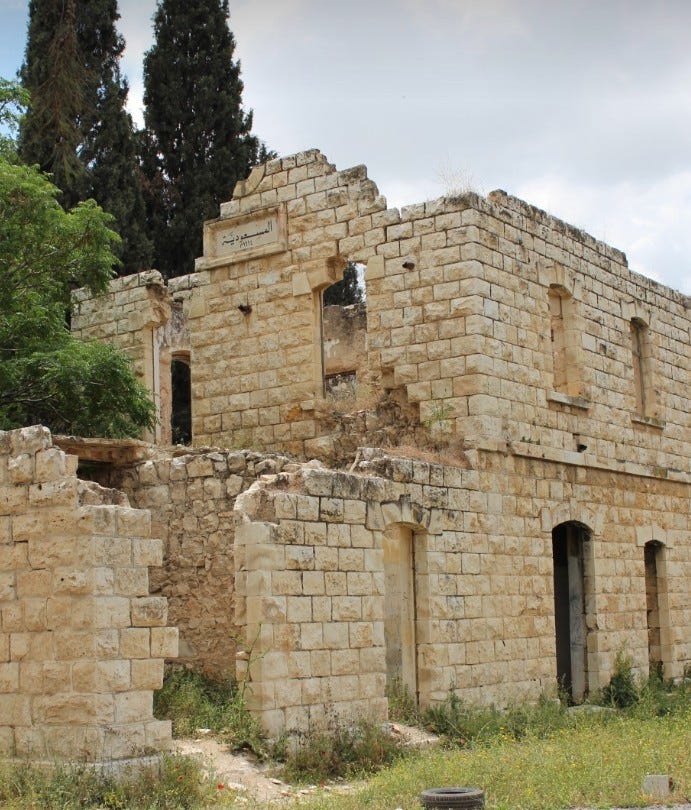
Sebastia, or Sebaste, is the Roman name for Samaria, and according to the Hebrew Bible, it was the capital of the Kingdom of Israel. This northern kingdom was established around 930 BCE, after the death of King Solomon, when Samaria split from the Kingdom of Judah in the south. Samaria fell to the Assyrians around 722 BCE, while Judah remained independent until it was conquered by Nebuchadnezzar in 586 BCE.
Today, Sebastia, 15 kilometers northwest of Nablus, is an archaeological site under Israeli jurisdiction. After the 1993 Oslo Accords, the archaeological site remained under complete Israeli control, and the adjacent Palestinian village came under the Palestinian Authority. The access roads to Sebastia are under Palestinian civil administration but Israeli security control. So the antiquities area is located chiefly under Israeli control; the site entrance, parking lot, coffee places, and souvenir shops are situated under Palestinian control.
Fifty years ago, at the end of November and beginning of December 1975, some 2,000 Gush Emunim activists marched to Sebastia, and hundreds remained for five days at the old Ottoman-era Sebastia train station to create a hilltop settlement. They had tried something similar in 1974 (an initial effort was made in 1969). In 1975, they were better prepared. The IDF stood by awaiting instructions from Defense Minister Shimon Peres and Prime Minister Yitzhak Rabin. All this happened days after the UN outrageously voted (at the instigation of the Soviet Union and Arab League) to equate Zionism with racism.
Peres told the Knesset that he knew of no principle that prevented Jews from settling in Samaria. Though in characteristic Peres-speak, he also pointed out that the Ministerial Settlements Committee had not approved a settlement in Sebastia. On the other hand, said Peres, the settlement was the Zionist retort to the despicable UN resolution.
But Sebastia was not settled. The government ultimately reached a deal with Gush Emunim to establish non-military settlements in the general vicinity of Sebastia. Kedumim, formalized in 1977, is about 20 minutes south by car. Among its residents is Finance Minister Bezalel Smotrich, leader of the Religious Zionist Party. Shavei Shomron, the nearest settlement to Sebastia, was also established in 1977. In 1979, Elon Moreh, overlooking Nablus, was established. Ofra, established in 1975, was the first settlement in Samaria, but it is well south of Sebastia, closer to Jerusalem than to Nablus.
Virtually all the original West Bank settlements between 1967 and 1976 were erected on public land claimed by no one or on ground that was Jordanian state property.
In 2025, rock-throwing by Arab youths is not uncommon, so visitors to Sebastia would be wise to go with a security escort. Fear of Palestinian violence has left the site in a state of neglect, and there is ongoing concern that the Arabs are looting the archaeological site. Some of the artifacts were long ago moved to the Rockefeller Museum.
Parenthetically, the Rockefeller located in east Jerusalem near the Old City (close to Herod’s Gate on Sultan Suleiman Street) has suffered a dearth of tourists since October 7, and its future is in limbo. There are rumors that it could fall under the political control of one or another settler-leaning NGO, or the Jewish Power Party-dominated Heritage Ministry, or, ideally, remain under the umbrella of the Israel Museum.
The Palestinian Authority says Jews have no historical connection to Sebastia. The Jewish settlers say that the Arabs have no national rights in the West Bank. In fact, the Sebastia site contains layers from Jewish, Phoenician, Roman, Byzantine, and Muslim periods. We Zionist Jews and the Palestinian Arabs both want to control the archaeological narrative. As I recollect, according to the biblical narrative, the Israelite kings who ruled the northern kingdom were mostly considered evil in the eyes of the Lord.
These days, the settlement enterprise would like to bring the site into the Israeli tourism grid, something vehemently opposed by the Arabs. The Palestinians complain that the settlers and the army are “storming” the site. They also refer to the Netanyahu government’s policy of encouraging thousands of Orthodox Jews to visit, pray, and even prostrate themselves on the Temple Mount as “storming.” I think they mean demonstratively visiting in large numbers. The tensions in and around Sebastia have led the IDF to move in and out of the Arab village regularly.
A few weeks ago, the Civil Administration announced it would expropriate 1,800 dunams (450 acres) in Sebastia, which reportedly covers the entire archaeological site, including parts the Palestinians now control, such as souvenir shops, eateries, and tour-guiding services, as well as nearby Palestinian-owned olive trees.
The government, prompted by the Heritage Ministry, which is under the control of Itamar Ben-Gvir’s Jewish Power Party, has allocated NIS 30 million ($9.2 million) to develop the site, build a new access road to Sebastia that will bypass unfriendly Palestinian villages, and enable the Israel Antiquities Authority to begin excavations. The Palestinian landowners in Sebastia and nearby Burqa have two weeks to file any legal objections. They fear that if the site becomes an archaeological park, they will be expelled from the area.
The present expropriation controversy over Sebastia is not merely about archaeology, though it is about that too. It is yet another manifestation of the zero-sum nature of the Palestinian Arab-Zionist conflict; two peoples claiming the same land and rejecting out of hand the legitimacy of the others’ claims.
On the ground, Israel has the upper hand; it can do whatever it wants. So far in 2025 alone, the government has informally allowed 68 outposts to be established across the West Bank, bringing the total to 141 established communities across the Green Line. Nowadays, private land is legally expropriated.
Nowadays, private Palestinian land is legally expropriated.
For their part, the Palestinians have time after time rejected an independent demilitarized state alongside Israel, and their rejectionism, combined with the messianic fervour of Binyamin Netanyahu’s long-entrenched stewardship, has catalysed a settlement growth that is premised not on any military strategy but on a sense that we are lords of the land.
In the international arena, the Palestinians have the upper hand.
A sizable segment of the Jewish Diaspora feels alienated from the policies of the Netanyahu government, and they can’t all be written off as self-hating quislings (even if a chunk is precisely that).
The Jewish State is also encountering unprecedented international isolation: in diplomacy 157 countries recognize a non-existent Palestine; in economics Netanyahu himself conceded that Israel faces isolation and embargo; in sports football associations worldwide have called for suspending Israel from competitions; in culture Eurovision, museum exchanges and artist boycotts are rampant; and in academia dozens of universities have suspended ties and research funding with Israeli academic institutions.
Yes, some countries like Germany will hold their noses and buy our weapons, but that alone is nothing to crow over.
Even American public opinion across the political and demographic spectrum is increasingly siding with the Palestinians.
The messianic, populist, ethno-chauvinist, and ultra-Orthodox supporters of the Netanyahu government don’t much care what the goyim say or do. They feed off Palestinian Arab intransigence and the duplicity of the international community. And to those of us who argue that not every Jewish right needs to be exercised, they say: Why not?
Those of us who understand that the Sparta formula is a losing scenario, that Israel’s political drift toward intolerance is internally corrosive, wonder out loud whether we should be doing more to change course — to, for example, move our “forever conflict” in a more non-zero-sum direction. For such thought crimes, the pro-Netanyahu and Channel 14 crowd tags us “Smolanim!” — “Leftist!”