
Book Review: No Safe Space
There Was Night and There Was Morning A Memoir of Trauma and Redemption By Sara Sherbill
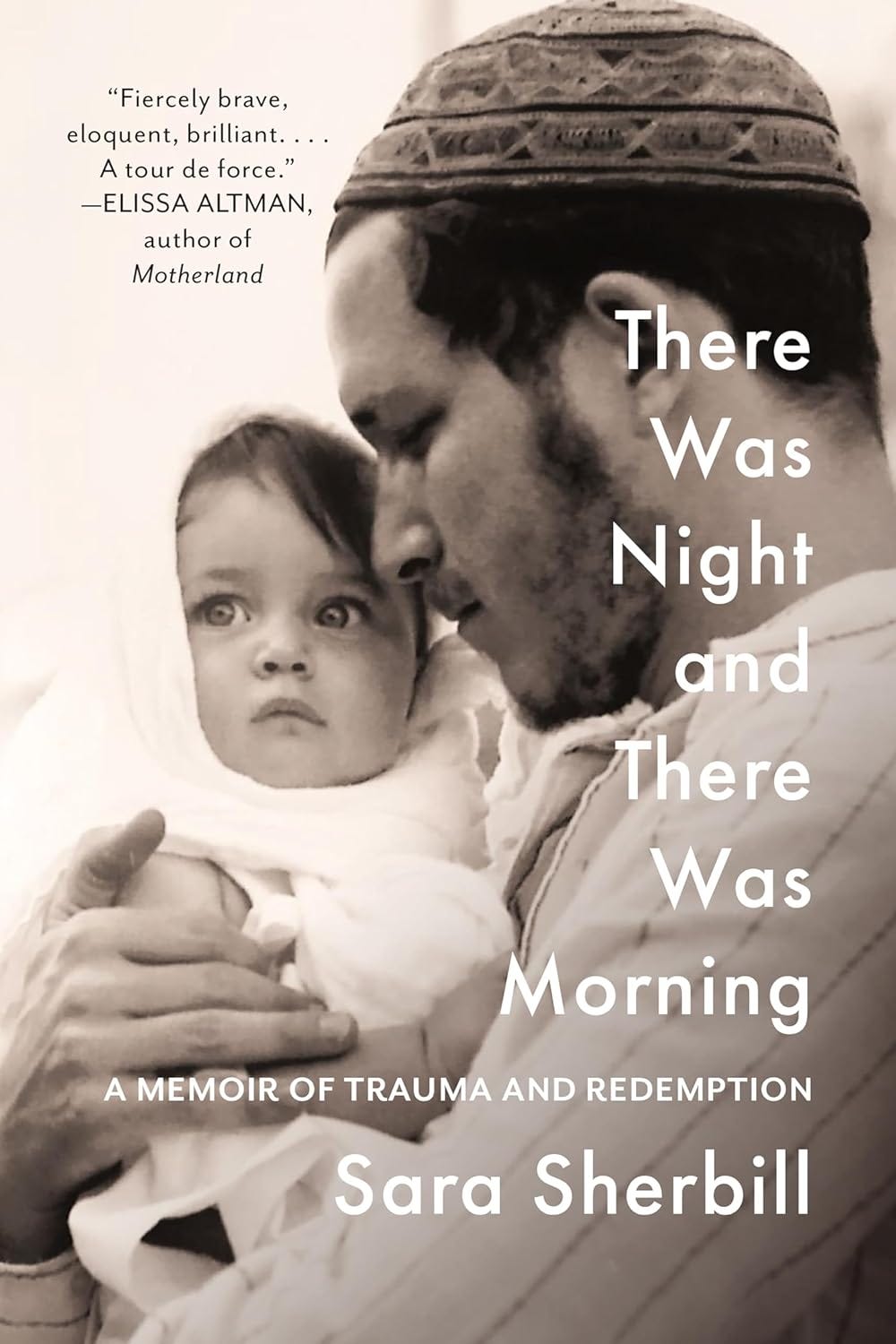
Her father was a respected American rabbi, popular and modish. On the outside, the family seemed to strike just the right balance between observance and openness. Her parents, from assimilated, financially comfortable families, met as volunteers on a kibbutz and shared a love of Israel, music, and Judaism. America proffered opportunities that Israel lacked, so they returned to the Old Country.
On the inside, family life was darker, as we learn in There Was Night and There Was Morning, an unforgiving memoir by Sara Sherbill, the eldest child. Her father is the book’s chief villain and wrecking ball; her mother, sister, and three brothers are his collateral damage. Sherbill feels herself responsible for everybody, and that is wearying, so much so that this is a challenging read, notwithstanding her artful writing. Sportswriter Red Smith, whom I remember reading in The New York Times, was once asked whether churning out a daily column wasn’t overwhelming. “Why, no,” Smith replied, “You simply sit down at the typewriter, open your veins, and bleed.” Sherbill is doing her emotional hemorrhaging on these pages.
She does not make herself the heroine of her own story; she will not cut herself any slack or engage in self-justifications. All the while daringly exposing her wounds – figurative and real. Not bad for someone whose credo was to remain in the background – don’t call attention to yourself.
This book is a quintessential woman’s memoir. It has taken me out of my comfort zone, but not so much that I can put it down.
Writing an engaging memoir is hard work, and this one did not come easy, hence the trauma and redemption of the title. Not everybody has a good story to tell or can tell it well; not every narrative has voyeuristic pull; and not every tale of perfidy and heartbreak (usually the prerequisites to a compelling memoir) presents a cathartic possibility. I am a tad partial as years ago, Sherbill and I worked together at a newspaper, and later, she helped me as an editor with my own memoir. That said, I think There Was Night and There Was Morning is —objectively speaking — as engrossing as it is unsettling.
The portrait I gather of her father is of an imposter. He is a college dropout, a baal teshuvah who never fully transitions to piety, and someone not comfortable in his own skin. He is not true to himself. Yet, he is somebody who is good at his clergyman role. He brings people “back to Judaism” as an out-reaching charismatic pulpit rabbi; he is a skilled, even compassionate pastor to his flock.
Foremost, he is the most influential figure in Sherbill’s life. Alas, he is not a nice person. He is moody; scarily unpredictable. She has felt his wrath, sometimes his belt, leaving her bruised and, even worse, feeling betrayed and embarrassed.
He is plainly discontented that he can’t control his anger or his cravings. He wants to be a good husband and father and behave at home the way his congregation perceives him in the synagogue. Perhaps the realization that he has failed so miserably leads him to narcotics, reckless sexual escapades, and nihilism.
His ego causes him to run afoul of his synagogue’s lay leadership, and his distemper at home gets only worse. He is the primary cause of Sara’s troubles, and no matter her efforts, even as an adult, to untangle herself from their toxic relationship, the poison seeps in. Her mother mainly enables her father to behave badly. She does not stand up to him and berates young Sara for pointing this out. Yet all along, Sherbill has defended her mother at no small risk, given her father’s vindictive streak. She finds herself forced to serve as the responsible parent to her psychologically wounded younger siblings.
Later, Sherbill is ambivalent about passing on her Jewish heritage to her son. “After what I’d seen, I could never send my child to a Jewish school. I could not pass down the thing I loved because it had hurt me too much.”
Sherbill is, as I said, utterly frank in her self-portrayal. We see her meanspiritedly berating her husband for losing his job even though she’s made it clear he’s a hard worker, and his boss is a very unpleasant person. At another point, though she is taking anti-anxiety medication, she’s on the brink of a breakdown, neglects to get a flu shot, and, sure enough, comes down with the virus. Here is the scene in their car with their young son in the backseat on the way to the emergency room on a snowy Christmas Day: “I scream at the top of my lungs. I scream because I am angry, and because I no longer care. I scream because I am mad at my mother and mad at my brother and mad at my husband and mad at God and mad at myself.”
To this reader’s relief, the beginning of self-compassion comes when Sherbill somehow (with the help of the right therapist) finds the strength to write down her story. If – and the jury is still out – it proves to be the catharsis she is aiming for – Sherbill may be able to find her way back to prayer and healing. When her father betrayed her, she felt that her Father in Heaven also did. Now, she is coming to terms: “God is the power above you, around you, inside you. Wherever you feel God, that is where God is.” No matter how much her father has tarnished it, Sherbill’s Judaism is too precious for her to abandon.
I sense she is on board with my own great pop psychology finding: no matter how much pain a father has caused — by striving to let go of our rage, we minimize our agony.